
To climb the rankings and move up in the search engines you need to create content that searchers and search engines want to see: SEO content.
Let’s see why it’s important and how to create SEO content, specifically geared towards search engine optimization.
1. SEO Content Basics
What is SEO content?
SEO content is content specifically designed to rank higher in search engines. It could be a blog post, a product or landing page, an interactive tool, or something else.
Why is SEO content important?
Not all content rises in the rankings and gets traffic from organic search. Only content created for searchers on the topics they’re searching for does, unless, by a stroke of luck, yours is the very content we’re talking about. But there’s a substantial difference between blind luck and dedicated work aimed at achieving the desired result.
2. How to create SEO content
Creating SEO content means giving users exactly what they want and making it “attractive.” If you can also share unique insights and expertise, even better. Let’s explore the process in more detail.
Choose a proven topic
You should already have an argument like this if you’ve done keyword research. It should be supported by evidence or real or existing situations, or at least appear to be so, and this translates into traffic potential, as well as business potential, and consequently ranking potential.
Let’s take an example. Imagine you sell bakery supplies and baked goods, and while doing a keyword search, you come across “muffin baking cups.”
We come to understand that “baking cups” has good business and traffic potential and seems easy to rank based on the keyword difficulty score.
To find it, we basically started with the main keyword “bakery,” then filtered for keywords with good traffic potential. Finally, we checked the top-ranking pages and their statistics in the SERP overview, discovering that they generally have few or no backlinks and come from unknown brands, so it seems like a pretty promising keyword to us.
Analyze search intent
Understanding search intent means understanding what people actually searching for on Google are looking for. This is highly recommended because your chances of climbing the rankings are slim if your content doesn’t align with this intent.
Very often, intent is inherent or revealed in the keyword itself. For example, it’s pretty clear that people searching for “SEO tips” want SEO tips. But for other keywords, it’s less obvious, so the best thing to do is use the top-ranking pages as a guide. In other words, try to deduce intent from what you see already in the top rankings.
To do this, analyze the top-ranked pages using the so-called three Cs method (an indication derived from the English terms):
- Content Type. Are they blog posts, product pages, landing pages, or something else?
- Content Format. Are they tutorials, lists, how-to guides, recipes, free tools, or something else?
- Content Angle. Is there a strong point, like low prices or “how easy it is”?
For example, the top results for the keyword “Neapolitan pizza dough” are all recipe blog posts, and the dominant content angle is authenticity.
Showcase your experience
Google tends to value content that demonstrates expertise in the topic. This can be even more important for topics that could impact a reader’s health, wealth, or happiness. Google itself defines these topics with an acronym (YMYL)—Your Money or Your Life.
Here’s what Google says about the experience for YMYL and non-YMYL topics:
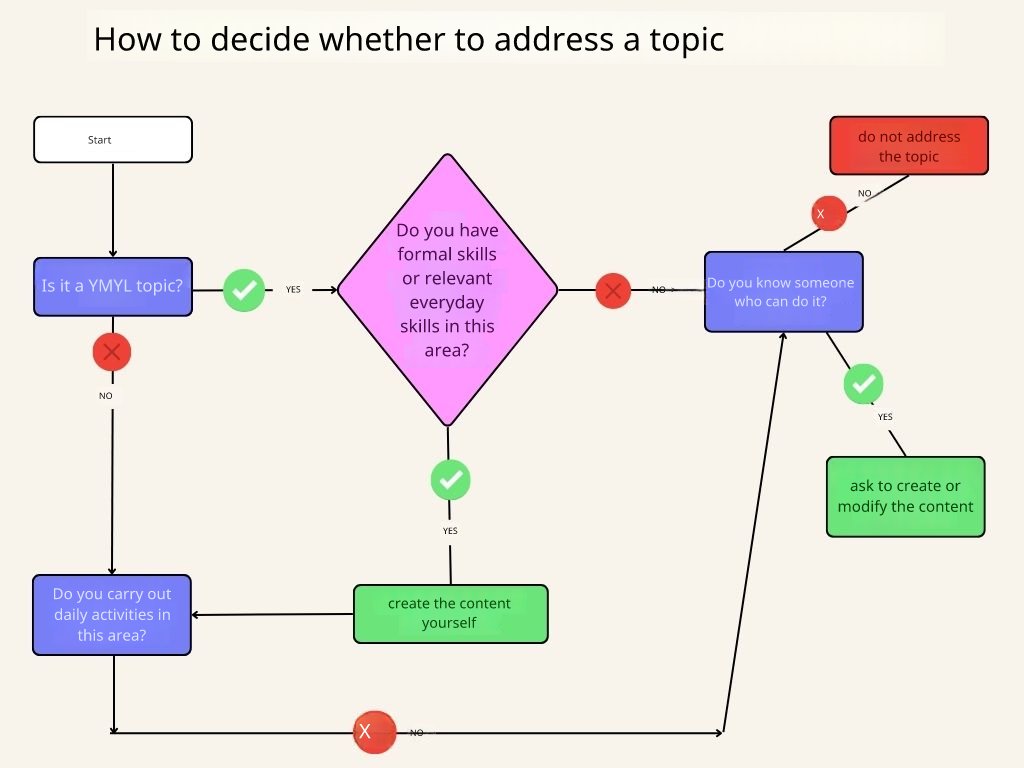
- Non-YMYL topics. “Everyday expertise,” that is, general expertise, is sufficient. The writer has the type and amount of life experience to become an expert on the topic; if you have this experience, you’ll fit right in.
- YMYL topics. Formal experience is considered important, but for some topics, “everyday experience”—that is, lived experience—is sufficient. For example, a housewife can answer “how to clean faucets properly” better than a plumber.
You can use the flowchart below to help you decide whether and how to cover a topic:
Cover the topic in its entirety
If you’re truly experienced in the topic, then it’s time to create the kind of content searchers want to see. Analyzing search intent gives you insight, but it doesn’t reveal everything. This is a problem because the best result for a query should cover everything searchers want to know.
Here are two ways to find important subtopics and points to include:
- Look for commonalities among the top-ranked pages. Subheadings are often revealing.
- Look for common keyword rankings among the top-ranking pages. These often reveal subtopics. And if they’re widely discussed, they’re probably quite important.
Make the topic unique
If you base all of your content on top-notch pages, you’ll end up with copycat content and won’t be able to stand out from the crowd or offer anything unique.
Copycat content is a problem for SEO because people have no incentive to link to it. And links are important because they’re a ranking factor.
Here are some ways to fix this problem:
- Provide original research. Surveys, research, and studies all serve this purpose.
- Provide a unique perspective or opinion. This could come from you, someone in your organization, or an industry expert.
- Build on what’s already available. Expand on key ideas, deepen, and offer alternatives.
Make the content “attractive”
Visitors will browse your website and stay there for a while if they find it confusing or difficult to read. This is a problem, because Google uses interaction data to evaluate relevance. If users abandon your content like the sinking Titanic, it’s unlikely to help your SEO.
Here are some tips to make your content more “attractive”:
- Keep it simple. Avoid complex words and sentences.
- Make your content visual. Intersperse text with images and videos.
- Speak your audience’s language. Use terms and jargon that resonate with readers.
- Check your spelling. Always do a spell check; it always makes a difference.
Keep your content always up to date
Content doesn’t update itself and stays relevant and up-to-date. This is especially problematic if you’re targeting a fast-moving topic. It means you’ll have to work to keep your content up-to-date to keep Google and search engines happy.
Searchers don’t want a list of the best Google searches from the past; they want something up-to-date. Any decline occurs when the content is outdated, and any increase occurs when the page is updated—this is now an axiom that holds true in most cases.
